
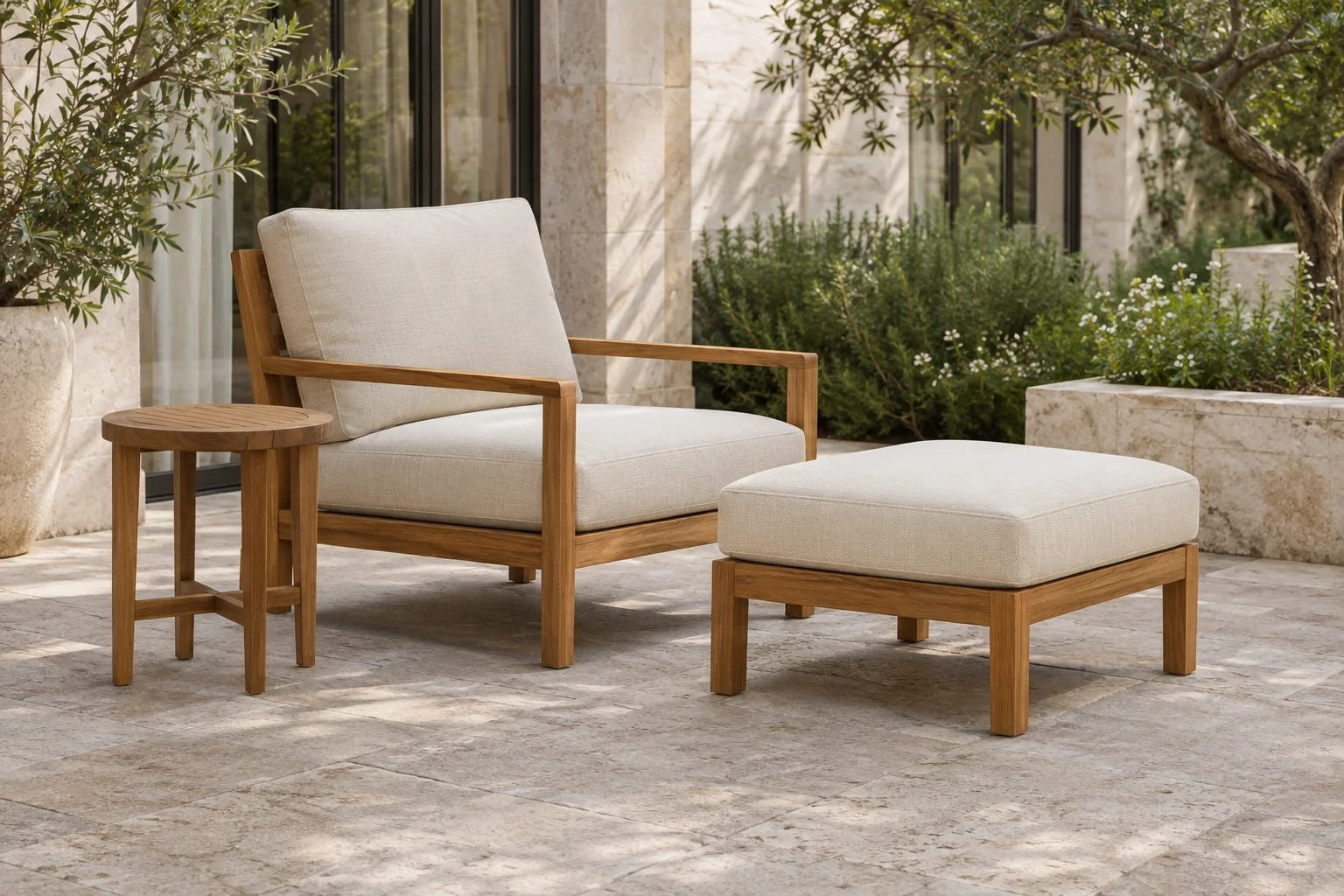
An outdoor ottoman is usually chosen as a footrest, but it may also be offered as an occasional seat or a place to put a tray. Those uses are not interchangeable. A soft top does not make a stable table, and a footrest should only become a seat when the manufacturer confirms that use.
Decide what the piece will do most often. For a hotel balcony, that may mean extending a lounge chair. In a larger seating group, it may need to move between guests. The intended job should determine the height, support and cushion construction.
Choose its main role first
| Main use | What matters most | What to verify |
|---|---|---|
| Footrest | Height and distance relative to the occupied chair | Comfort with the chair cushion compressed under a seated person |
| Occasional seat | A frame and top designed for sitting | The maker’s permitted use, load information and stability |
| Tray surface | A firm, stable support surface | Whether tray or table use is intended for that design |
| Part of a modular sofa | Compatible height, cushion alignment and connections | The approved arrangement and whether the units connect |
It is reasonable for one model to perform several jobs. The important point is that those jobs should appear in the product specification, rather than being inferred from a lifestyle photograph.
Compare heights with someone sitting down
A catalogue lists the unoccupied height. Your guest experiences the chair with the seat cushion compressed. If the ottoman has a firmer or thicker cushion, two pieces with matching listed heights may feel quite different when used together.
Try the actual pair. Sit back in the chair, place your feet on the ottoman and adjust the distance. Check whether the seat edge presses behind the knees or whether reaching the footrest makes you slide forward. There is no single height difference that works for every chair, cushion and user.
For projects, keep the approved chair and ottoman specifications together. Replacing just one cushion later can change the relationship between them. Vectraout’s article on deep-seated garden furniture explains why the frame and cushions need to be assessed as one sitting position.
Check what is under the cushion
Lift the cushion during the sample review. Look at the support, fastening points, underside and feet. Ask whether the piece is designed to be lifted by the frame and how it is moved for cleaning. A removable cushion is not a carrying handle.
If occasional seating is part of the brief, ask for the evidence relevant to that use. Do not invent a safe load from the size of the legs. A model described only as a footstool may have different limitations from an ottoman specifically offered as a seat.
For wooden designs, specify the timber rather than accepting a general description such as “hardwood look.” Vectraout’s wooden outdoor furniture uses teak; frame proportions and the finished construction are agreed against the project specification.
Be realistic about the coffee-table idea
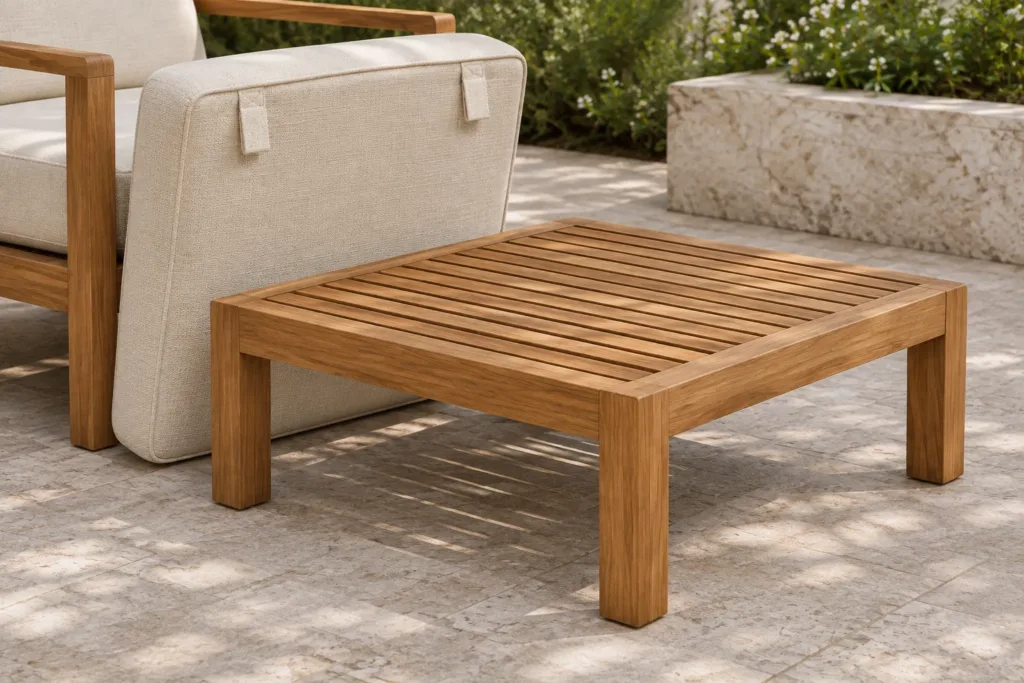
A tray on a cushion can look convincing in a photograph. In use, the surface may move when someone shifts their feet or sits on the edge. Before treating an ottoman as a table, check whether the maker intends that use and test it with the proposed tray.
For regular drinks service, a separate firm-topped table is often the more workable arrangement. It keeps a place for glasses available while the ottoman is being used as a footrest. Do not use a soft cushion as the support for hot drinks or unstable glassware.
Likewise, removing the cushion does not automatically reveal a tabletop. The support underneath may have wide gaps or fittings intended only to hold upholstery. A dual-purpose design needs an appropriate surface in both configurations.
Leave room for it to move
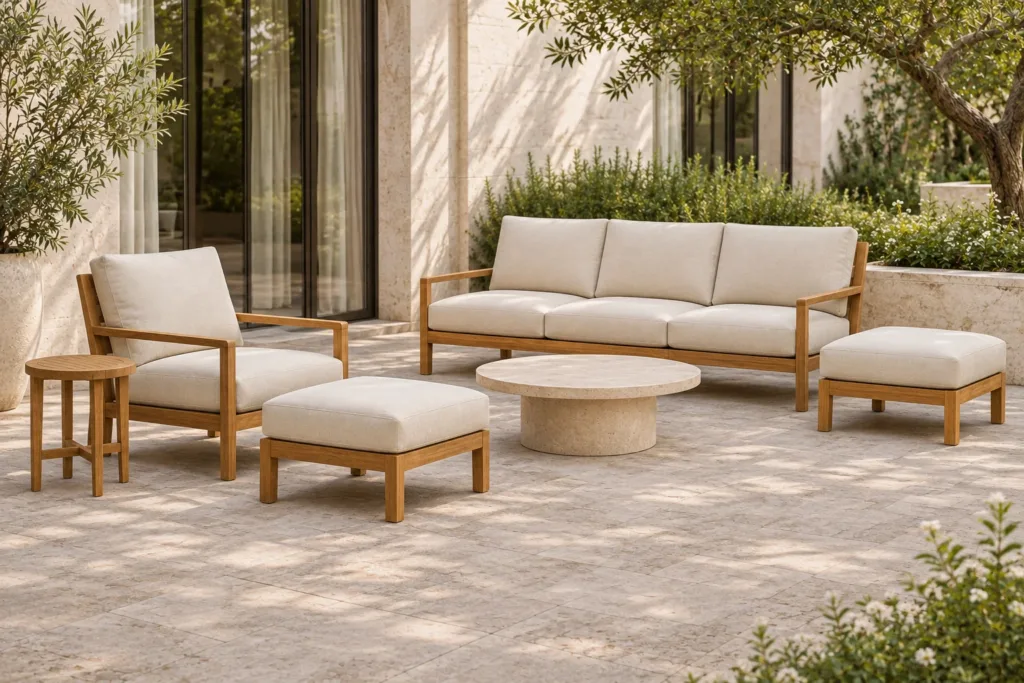
Draw the ottoman in its working position and in its parked position. A terrace can appear spacious with every piece pushed under a sofa, then become difficult to walk through once guests put their feet up.
On a hotel balcony, check the door swing and the route to the railing. In a shared lounge, keep the main walking route outside the group rather than between a chair and its footrest. The question is not only whether the furniture fits, but where it goes while it is being used.
Plan the cushion care
An ottoman cushion may meet shoes, bare feet, sunscreen and food. Choose the fabric and cleaning method around those conditions. Retain the fabric reference and the care instructions for the complete cushion.
A zip does not establish that a cover can be machine washed. Sunbrella’s upholstery care instructions, for example, advise checking with the furniture manufacturer before removing casings because construction varies. Follow the instructions for the fabric and finished item you actually purchase.
If the terrace is exposed, discuss the filling and drainage construction as well. Our article on custom outdoor cushions covers the information to keep for later replacements.
Common questions
Can an outdoor ottoman be used as a seat?
Only if the particular design is intended and specified for sitting. Ask for its permitted use and supporting information; do not assume every footrest is an extra seat.
Should it be the same height as the chair?
Matching listed heights are a starting point, not a comfort guarantee. Compare the pieces with the chair occupied and the cushions compressed, then test the distance between them.
Can the cushion stay outside in the rain?
Follow the complete product’s care instructions. Fabric, filling, seams and the base all influence how the item handles water. A water-resistant fabric description alone does not answer the question.
Specify it with the seating
For a coordinated lounge, send Vectraout the chair or sofa dimensions, the intended ottoman use and the available floor area. We can discuss teak construction and upholstery around that brief. Send the reference and dimensions before fixing quantities.