

For most of the week, a four-person table might be all the terrace needs in that corner. Then a group books for Saturday and staff have to find more seats without rearranging half the terrace. One well-placed extendable outdoor table can make that change easier.
Choose the table for both layouts. Check what happens to the legs and the nearest service route when it is open, and make sure it is still useful on an ordinary day when it stays closed. The six examples below show how differently tables with similar closed lengths can expand.
Work out how much length the terrace can spare
Draw the table first as you expect to use it most days. Include people in the chairs, then draw the extended top, the new chair positions and the room needed to pull them out. Use the same reference point, such as the edge of a planter, on both drawings.
For example, a table that goes from 1,800 to 2,400 mm adds 600 mm of length. A central expansion might add 300 mm at each end. If the venue normally keeps one end aligned with a fixed feature, the whole change might need to fit at the other end after repositioning. Verify how the actual model moves. A useful plan shows the top, legs and occupied chairs in both positions.
That extra length also needs somewhere to go while the staff are opening the table. If they have to pull out chairs from another group, ask how often that will happen and whether they can prepare the table before service.
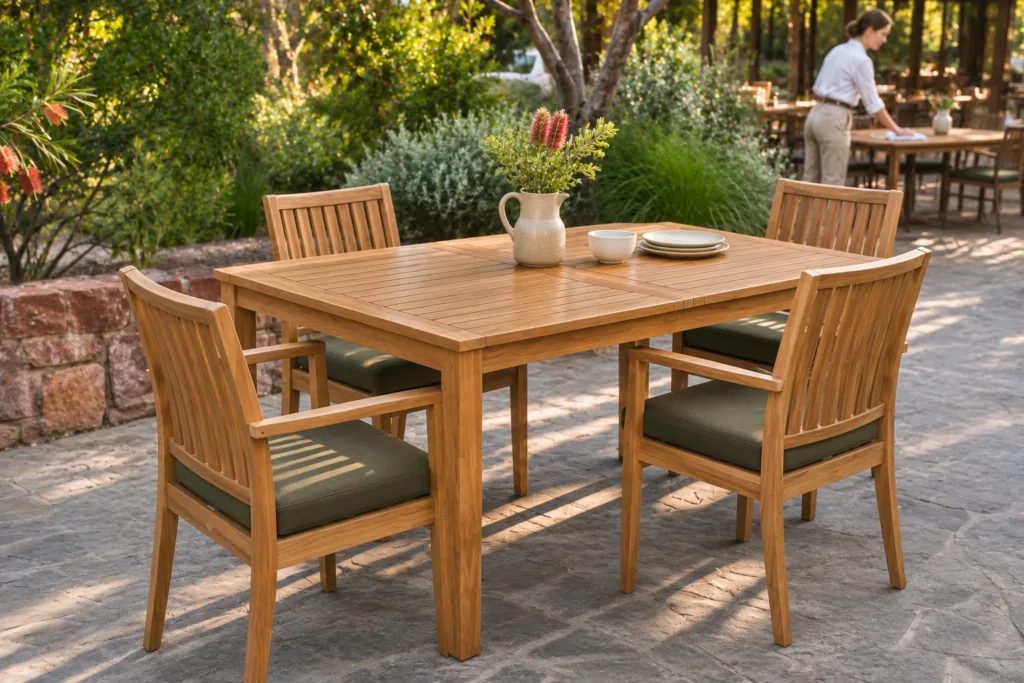
Six extendable outdoor tables to compare
Dimensions are the makers’ published tabletop sizes, shown in centimetres. Test your chairs with the actual table, especially if you need to seat anyone at the ends.
| Model | Closed → open length | Width | What makes it worth comparing | Source |
|---|---|---|---|---|
| Nardi Tevere Lam 147 Ext. | 147 → 211 cm | 90 cm | A relatively compact closed size and a laminate top with a coated aluminium frame | Nardi |
| Fermob Ribambelle, two extensions | 149 → 234 cm | 100 cm | Two leaves and storage under the top. Useful to try where the same setting serves several group sizes. | Fermob |
| Jati Creswick Teak Extension Table | 180 → 240 cm | 105 cm | A teak option with enough width to trial shared plates and place settings together | Jati |
| Santiago Extendable Dining Table | 200 → 260 cm | 100 cm | A teak top on a charcoal frame. Compare its longer closed format with the space available on busy days. | Lume Outdoor Living |
| Nardi Rio 210 Ext. | 210 → 280 cm | 100 cm | A sliding frame keeps the support legs at the ends as the table opens. | Nardi |
| Osier Belle Outdoor Dining Extension Table | 220 → 340 cm | Confirm for the ordered version | A made-to-order teak option with a choice of leg designs. Compare the approved leg drawings before settling the seating plan. | Osier Belle |
Look at the legs in the position you will actually use
Some frames move the end legs outward as the top expands. Others add tabletop length while the main supports stay in place. A seat that appears on a plan can still land directly in front of a leg or beneath a support bar. Try the chosen chair at each proposed place, including the ones directly beside the join.
Measure the clear height below the top and the available width between supports. Check upholstered arms with the actual cushions installed. If the seat at the head of the table is important for group bookings, let someone sit there while staff pass behind them. Outdoor dining table sizing and chair fit
Rehearse the change before guests arrive
Have the people who will run the floor open one empty sample as the maker directs. Check where each leaf is stored, how it is handled and what tells the operator it is seated correctly. A leaf that lives under the table avoids a separate trip to the store. It can also change the underside clearance.
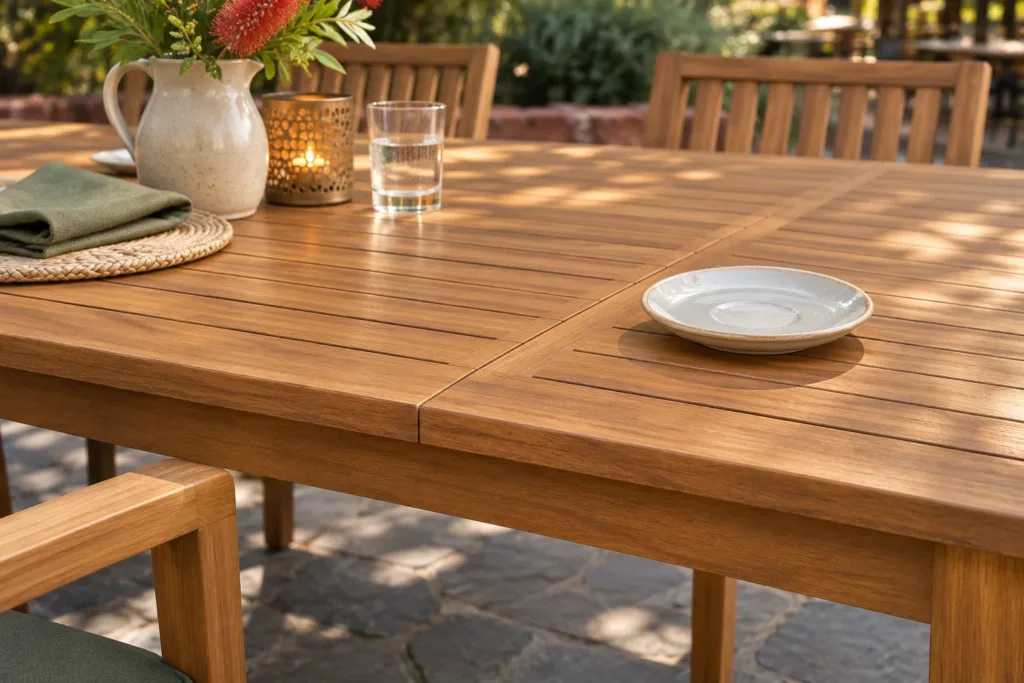
Try the actual crockery across the joins. A join can be neat enough to look at but sit just high enough to catch the foot of a small glass. Check the edges, level and cleaning access with the table in both positions. For teak, follow the furniture maker’s care instructions and ask how to clean where the leaves meet.
Give the extended layout a place on the floor plan
Identify which space for spare chairs still works when the table is open. If you usually seat one large group at a particular end of the terrace, agree that position before ordering. Two compatible square tables that join neatly are another option for a venue that regularly changes its layout. Café table shapes for outdoor service
For a custom teak table brief, send your two floor layouts, the selected chairs and the biggest group the table needs to serve. Add the maximum length you can accommodate on a busy night. Send your table brief to Vectraout
Frequently asked questions
Does a longer table always add two seats?
Check the place settings, chair widths and support positions. The extra length may create room for two guests in one setting and give the existing guests more room in another.
Which is easier for a restaurant, integral or removable leaves?
Integral leaves keep all the parts at the table. Removable leaves may suit a venue with dedicated storage and an assembly routine. Have staff try the operation and check the space under the table before deciding.
Can an extendable table stay outdoors all year?
Check the actual finish, hardware, mechanism and manufacturer’s care instructions for your location. Ask whether the table has a recommended storage or weather protection routine.
When should I use two separate tables instead?
Two tables keep a regular layout flexible when small bookings are common. An extendable table can make more sense when a broad, continuous surface matters and the terrace has room for it in its open position.