
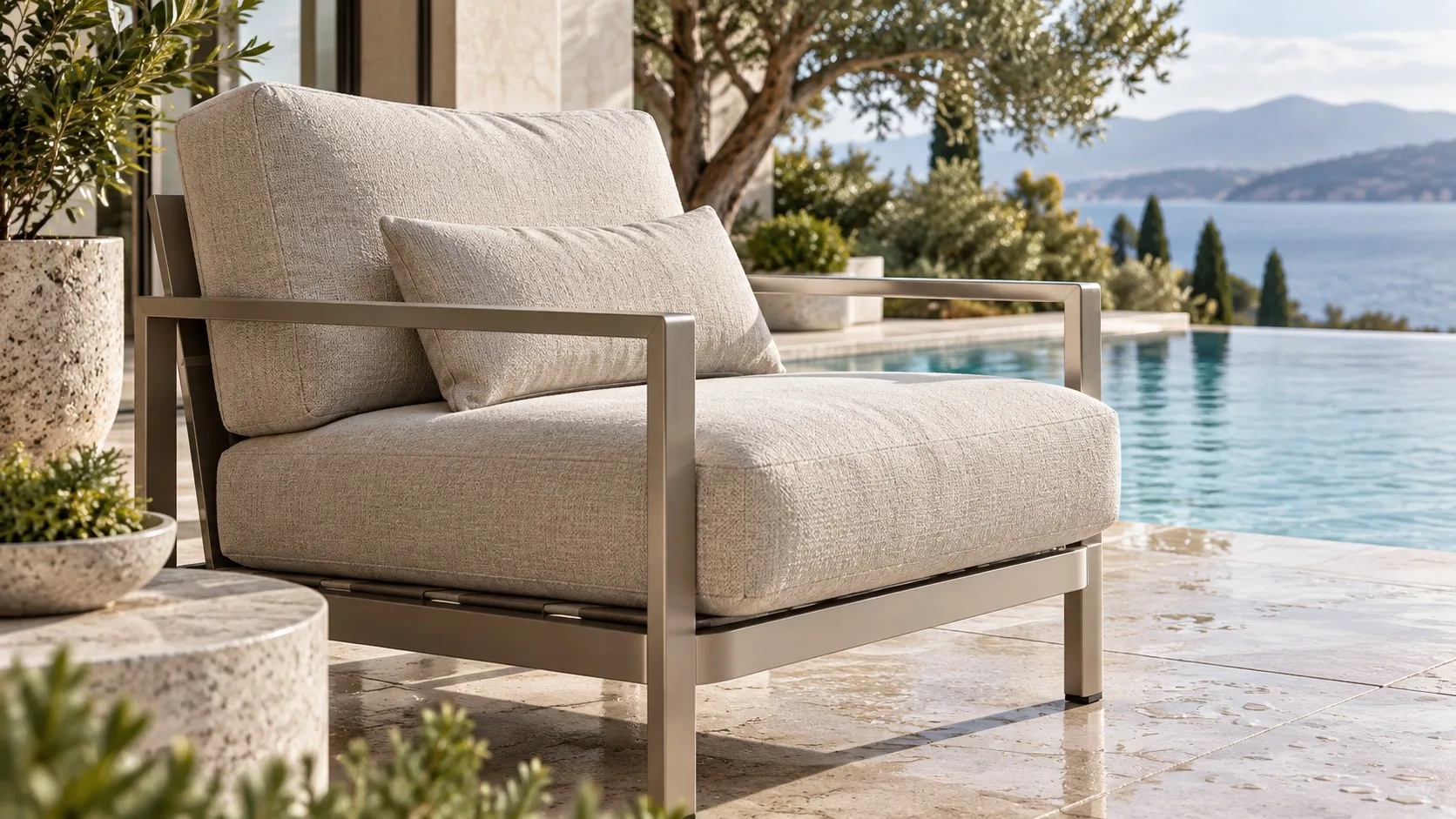
Quick dry foam for outdoor cushions usually refers to foam selected to let water drain and air circulate, often using a reticulated open-cell structure. It is not a waterproof barrier. A cushion’s actual drying performance also depends on its fabric, liner, seams, underside, supporting base and the conditions where it is used.
If a cushion stays wet after rain, changing the visible fabric may not solve the problem. Water management belongs to the whole cushion assembly. That is particularly important for exposed terraces, poolside seating and hospitality spaces where furniture must return to use predictably.
What is reticulated foam?
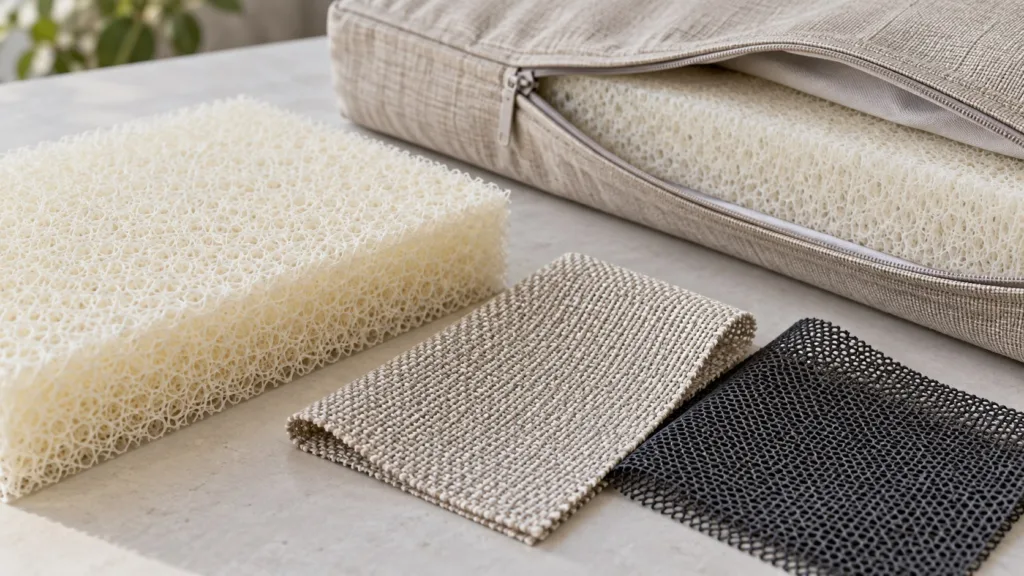
Reticulated foam has a highly interconnected open structure that allows air and water to move through it. Urecel’s reticulated-foam explanation describes this structure and its role in applications requiring flow through the material.
Do not treat every description of open-cell foam as the same specification. Conventional upholstery foams can also be described as open-cell. Ask whether the proposed material is reticulated, which grade is being supplied and what application its maker recommends.
Also distinguish a general drying description from a named product. Urecel QuickDry is a specific manufacturer’s system, while other suppliers offer their own foam types. Similar wording in a quotation does not establish that the materials are identical.
Is quick dry foam the same as waterproof foam?
No. A draining foam allows water to pass through its structure. A low-water-absorption closed-cell foam works differently, and the feel and suitable applications may differ as well.
Sailrite’s upholstery-foam comparison separates reticulated Dry Fast foam from closed-cell flotation foam and other upholstery materials. These are choices for different needs, not a ranking in which one type is automatically best for every outdoor seat.
For patio seating, evaluate drainage alongside comfort, support, expected frequency of use and the cover design. Do not choose a very different cushion construction solely because it sounds more waterproof.
Why the cushion cover matters as much as the foam
Imagine a foam sample that drains readily on a workbench. That behavior may change when it is placed inside a complete casing, set on a solid support and covered by a wet pillow. The assembly can create restrictions the loose sample did not have.
Review these parts together:
| Part of the cushion | What to establish | Useful question |
|---|---|---|
| Foam | Type, grade and intended application | Is this grade recommended for the actual use frequency? |
| Cover fabric | Water behavior and care requirements | How is this fabric intended to work with the filling? |
| Liner or wrap | Whether it changes moisture movement | What is the purpose of each layer? |
| Seams and closures | Construction and maintenance access | Where can water enter, and how is the cushion serviced? |
| Underside | Drainage or ventilation arrangement | What route lets moisture leave the finished cushion? |
| Furniture base | Support and clearance underneath | Is the cushion being assessed on the actual chair or sofa? |
An underside mesh can be part of a design, but its presence alone is not a guarantee. The full construction and the manufacturer’s instructions still need to agree.
Density, firmness and thickness are different questions
Foam density describes mass for a given volume. Firmness describes how the foam responds to compression under a specified measurement. Thickness is a physical dimension of the cushion. None of those numbers can replace the others.
Sailrite’s guide to foam terminology explains why foam selection needs more than a description such as soft or high density. When comparing figures, check that units and test methods match.
For example, a thicker cushion made with one foam grade is not automatically more supportive or longer lasting than a thinner cushion made with another. Seat dimensions, the supporting platform and the user’s preferred comfort also affect the result.
Request a finished seat sample at the intended thickness. A small foam swatch is useful for material discussion, but it cannot reproduce the experience of sitting on the complete chair.
Does every outdoor cushion need quick dry foam?
Not necessarily. Consider the exposure and operating routine. A cushion brought into dry storage before rain presents a different problem from an unattended cushion on an open pool deck.
| Intended use | What to prioritize in the discussion |
|---|---|
| Sheltered patio with regular storage | Comfort, care method and the actual exposure recommendation |
| Uncovered lounge area | Complete cushion water management and realistic drying arrangements |
| Poolside seating | Wet-use conditions, cleaning, underside design and replacement planning |
| High-use hotel seating | Foam grade suitability, support retention and relevant use evidence |
| Seasonal furniture | Storage requirements and the complete cushion’s care routine |
Drainage and heavy-use durability are separate properties. For instance, Sailrite’s foam sample guide identifies an intended use profile for its Dry Fast foam. Confirm the grade and current recommendation rather than assuming any quick-dry product is suitable for constant commercial use.
How should you evaluate a sample?
Start with a finished cushion on the intended furniture base. Confirm the material names, dimensions, layers and care instructions, then agree on a practical review method with the supplier.
Assess normal sitting comfort and recovery after use. Review whether the cushion stays positioned as intended, whether the casing fits correctly and whether any liner or base detail conflicts with the drainage design.
If you review wetting and drying, use an approved method and record the conditions: water exposure, cushion thickness, temperature, airflow and the surface supporting it. A demonstration in warm moving air does not establish the same drying time in a humid shaded terrace.
Do not convert the demonstration into an unsupported promise such as ready in thirty minutes. Ask what evidence supports any stated drying claim and what conditions it covers.
What should a cushion quotation include?
For a meaningful comparison, request the foam maker and grade, density and firmness information where relevant, dimensions, fabric, liner or wrap, underside construction, intended use and care instructions. Include the replacement cushion reference and warranty conditions.
Record whether a foam substitution requires approval. An order described only as outdoor fabric with quick-dry filling leaves too much uncertainty when comparing samples with production items.
For hospitality procurement, also ask how the manufacturer supports repair or replacement. A usable cushion specification should help the operator reorder the correct item, not only approve its first appearance.
Frequently asked questions
How fast does quick dry foam dry?
There is no universal time for every foam or finished cushion. Material grade, thickness, casing, airflow, humidity and exposure all matter. Evaluate any time claim against its stated conditions and the complete assembly being supplied.
Can a quick-dry cushion stay outside all year?
Not on the foam description alone. Follow the furniture and cushion instructions for the climate and season. Drainage does not remove the need for cleaning, drying before storage or protection required by other components.
Does antimicrobial foam eliminate cleaning?
No. A treatment claim does not remove dirt or replace maintenance. Ask what the treatment applies to and follow the cushion’s care instructions. Cleanability and the condition of every layer still matter.
Is a water-repellent fabric enough?
It does not establish the performance of the filling or complete cushion. Review how the fabric, seams, liner and underside manage water together, then confirm that the finished cushion suits the intended exposure.
Specify the complete seat, not just the foam name
When discussing outdoor lounge furniture, explain the climate, wet-use conditions, use frequency and preferred comfort. Treat the foam, cover, liner, seams and furniture base as one specification. For related decisions, compare our custom outdoor cushion specification guide and outdoor cushion cover guide.
You can send a cushion or custom furniture brief to vectraout. Ask for the available construction and a finished sample that reflects the proposed production specification.