
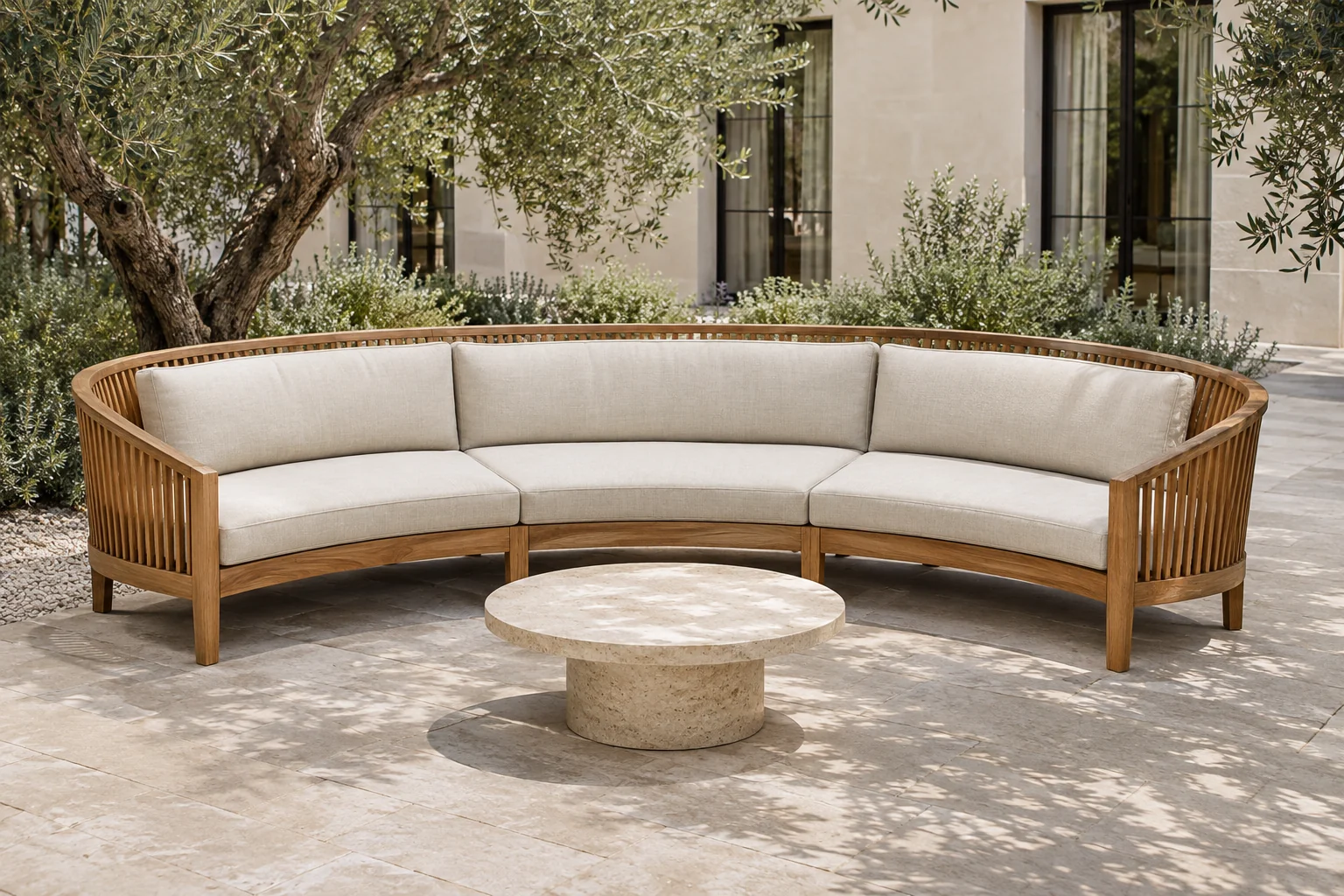
A curved outdoor sofa works best when it gives a seating group a clear centre without closing the route around it. Before choosing one, check its full footprint, the usable length of the seat and how people will reach a table. The curve is only useful if those details work together.
On a hotel terrace, a shallow arc can turn a loose collection of chairs into a comfortable place for conversation. In a narrow strip beside a building, the same sofa may leave an awkward pocket behind the back and too little room in front. Start with the space rather than the silhouette.
Measure the whole shape
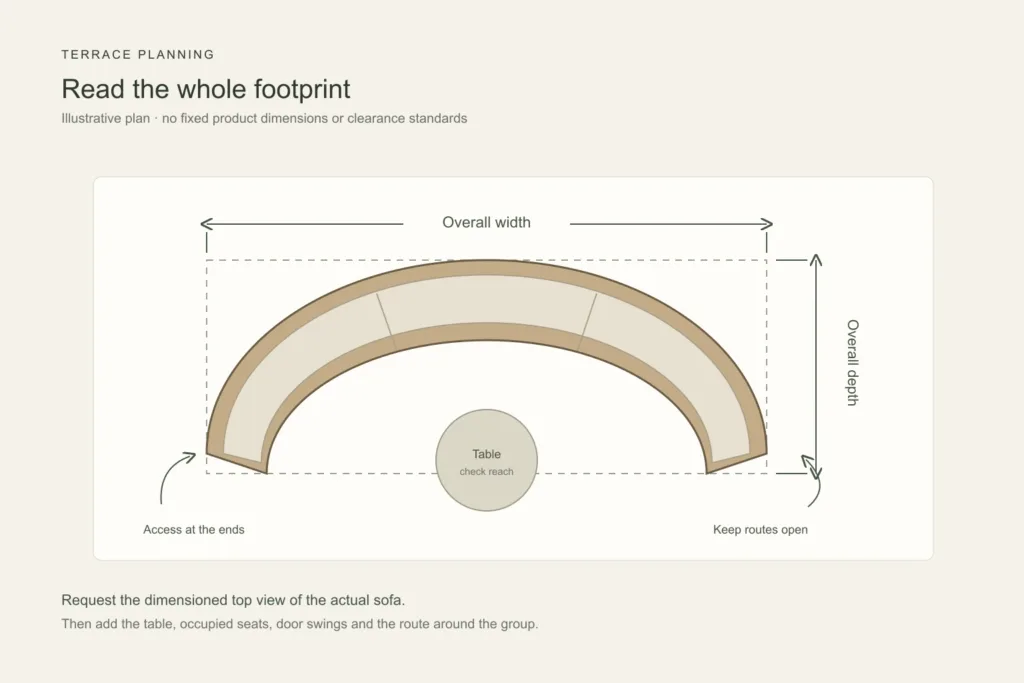
The stated width rarely tells the whole story. Ask for a dimensioned top view showing the widest point, the total front-to-back depth and the shape of the back. A curved sofa’s seat depth and its overall plan depth are different measurements.
For a simple comparison, imagine two shortlisted sofas that are both 3.2 metres wide. One has an overall depth of 1.5 metres; the other is 0.9 metres deep. The first uses another 0.6 metres of the terrace before a coffee table or a walking route is added. These are example dimensions, not standard sizes, but they show why equal width does not mean equal fit.
Mark the outline with tape, including the ends and the widest part of the back. Then add the table and the route people actually use. Check doors, planters and the path from the bar or restaurant. Our article on arranging outdoor furniture explains how to build those routes into a measured plan.
Where a curve earns its space
| Terrace setting | What the curve can offer | What to check first |
|---|---|---|
| A square or generously proportioned lounge area | A seating group focused on one central table | Access at both ends and usable space behind the back |
| A freestanding seating island | An attractive back visible from the surrounding terrace | Rear finishing, cleaning access and the route around the group |
| A long, narrow balcony | A softer outline, if the curve is shallow enough | Overall depth; compare it with a straight sofa before committing |
| A terrace that changes between events | Several arrangements, if separate modules allow them | Module shapes, connections, storage and approved configurations |
A curve does not automatically create more seats. A long outer back can surround a much shorter inner seating edge. Ask how many individual sitting positions the design is intended to accommodate, then test the sample with people seated normally.
Try the table from every seat
A round table often sits neatly inside an arc, but a good-looking plan can still be uncomfortable to use. Sit at the middle and at both ends. Can a guest put down a glass without stretching or shifting to the edge of the cushion? Can someone stand up while another person remains seated?
For a larger sofa, two smaller tables may work better than one oversized centre table. Keep them within reach without filling the opening through which guests enter the group. Avoid choosing the table diameter from a photograph alone.
Decide whether it needs to move
A one-piece curved sofa and a curved sectional create different operational demands. A fixed frame can keep a clean continuous line. Separate units can make delivery and replacement easier, but only if their sizes suit the access route and their connections suit the intended arrangement.
Record the largest individual component, not just the assembled sofa size. Measure gates, corridor turns, lift doors and the final approach to the terrace. Ask how the parts are lifted, joined and separated. Do not assume a sectional can be rearranged into any shape simply because it comes in pieces.
Choose cushions that can be replaced
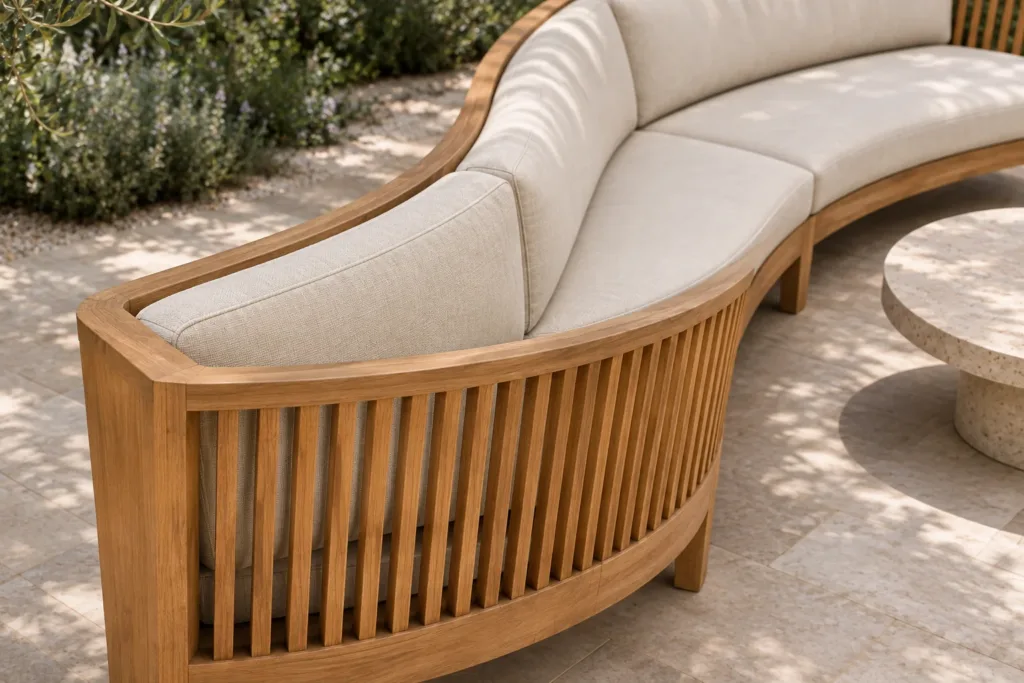
Curved seating may use wedge-shaped cushions, shaped backs or different end pieces. Keep an approved drawing and identify each cushion position. A general description such as “three-seat sofa cushion” will be of little help when one cover needs replacing later.
Check the fabric against the terrace’s exposure and cleaning routine. The Association for Contract Textiles’ performance guidelines cover several aspects of fabric performance. Its abrasion disclaimer also explains why a laboratory abrasion result does not predict service life. Review the exact fabric specification rather than choosing by one impressive number.
For an exposed site, discuss the complete cushion construction as well as the cover. Our explanation of quick-dry foam for outdoor cushions covers the questions worth asking before a sample is approved.
Questions before you order
Does a curved outdoor sofa save space?
Sometimes, particularly when it follows the usable shape of a terrace. It can also use more depth than a straight sofa. Compare dimensioned plans and occupied layouts rather than width alone.
Can it sit against a straight wall?
It can, but the curve may leave a gap behind part of the frame. Decide whether that gap can be cleaned and whether the remaining room still works for guests. A straight sofa may be the more practical choice on a tight terrace.
Is modular seating always easier to deliver?
Only when each separate unit fits the delivery route. Check the packed and unpacked dimensions of the largest module and confirm how it will be handled.
Start with a plan, not a finished seating count
Send Vectraout a terrace plan, access dimensions and a reference for the shape you have in mind. We can discuss teak frames, cushion specifications and a layout suited to the brief. A sketch with clear dimensions is enough to start the conversation.