

For routine cleaning of teak outdoor furniture, start with the care instructions for its finish, remove loose dirt, and use an approved mild cleaner with a soft brush. Rinse gently and let the furniture dry. Cleaning dirt, removing a silver patina and restoring an applied finish are different jobs; choose the method for the result you actually want.
Teak can look gray and still be clean, or look golden and still need cleaning. Treating every change of color as a problem often leads to unnecessary scrubbing or an unsuitable coating. Before reaching for a cleaner, decide whether your goal is routine washing, stain treatment or a deliberate change in appearance.
Is the teak natural, sealed or finished?
Identify the product and its surface treatment first. Natural teak, a sealed surface and a factory-applied weathered finish may need different care. If you cannot identify the finish, ask for the original specification or check with the supplier before trying to remove it.
RH’s teak care sheets provide separate guidance for natural teak and its weathered or aged finishes. The practical lesson is to follow the actual finish rather than a generic instruction for teak wood.
Photograph the furniture before cleaning. Note any loose joints, split components or lifting finish separately from dirt. Cleaning may improve appearance, but it does not repair a structural issue.
Does gray teak need restoring?
Not necessarily. Natural silvering can be part of the intended appearance. If you like that surface, the objective is to remove contamination without aggressively stripping its weathered color.
Kingsley Bate’s care-products guide distinguishes ordinary cleaning from using a teak cleaner that removes the gray patina. A product called teak cleaner can therefore do more than a mild maintenance wash.
Decide on the desired result before buying a product. For a coordinated furniture set, test on a hidden area and consider how treatment will affect matching pieces. One newly brightened chair may stand out beside the rest of a naturally weathered collection.
A gentle routine for ordinary dirt
Prepare clean water, an approved mild soap or teak-care product, a soft non-metal brush, and a place where the furniture can dry. Protect nearby surfaces as instructed on the cleaner’s label, and remove cushions and loose accessories.
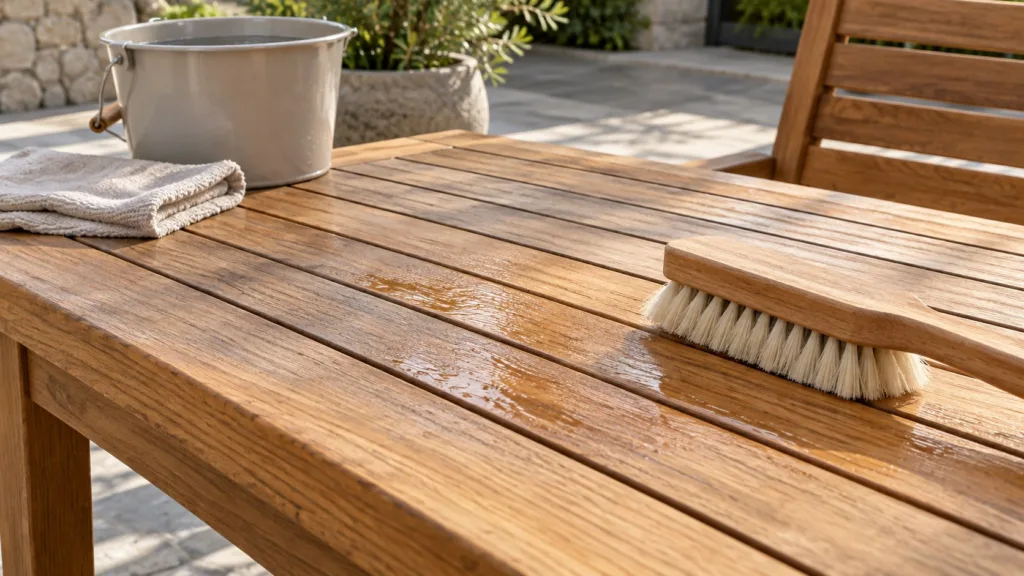
For natural teak whose care instructions permit wet cleaning, use this sequence:
- Remove loose debris. Brush away leaves, grit and surface dirt without gouging the timber.
- Wet the wood if the method requires it. Use a gentle water flow rather than concentrated force.
- Apply the approved cleaner. Follow its dilution and contact instructions. More concentrated is not automatically more effective.
- Work lightly with the grain. Focus on contamination rather than forcing the whole surface back to a new-wood color.
- Rinse as instructed. Remove the cleaning solution from slats, corners and accessible joints.
- Allow thorough drying. Review the result when dry before deciding whether any further treatment is needed.
Country Casual Teak’s cleaning guide describes mild cleaning and working with the wood grain. Its instructions also distinguish preserving a gray surface from changing the color. Keep that distinction in mind when deciding how much cleaning is enough.
Should you pressure wash teak furniture?
A pressure washer is not the default tool for teak. Gloster’s teak guidance warns against it because it can erode the surface. Forceful cleaning can turn a straightforward wash into a surface-repair job.
Use the product’s approved low-pressure method instead. If ordinary cleaning is not removing the mark, identify the stain and review the instructions rather than increasing force. Dirt in a joint or a darker patch is not a reason to blast the entire piece.
Avoid copying a pressure-washing demonstration made for paving, plastic furniture or a different timber. Similar-looking outdoor surfaces can require different treatment.
What if stains remain after cleaning?
Let the furniture dry before judging the outcome. Moisture changes the appearance of wood and may temporarily hide or exaggerate marks. Then decide whether the issue is surface contamination, natural variation or deterioration of an applied finish.
| Condition after drying | What to establish next | Appropriate direction |
|---|---|---|
| General dirt remains | Whether the approved wash reached the affected area | Repeat gently only within the product instructions |
| A localized food or oil mark remains | The stain type and finish compatibility | Use the maker’s specified spot treatment |
| The gray color remains evenly | Whether silvering is an accepted appearance | No restoration is required solely because it is gray |
| A finish is peeling or patchy | What coating was originally applied | Follow a finish-specific repair process |
| A component is loose or damaged | Whether the furniture needs repair | Resolve the defect before returning it to use |
Do not sand simply because a mark has survived one wash. Sanding changes the surface and may alter a coating or the appearance of matching pieces. Obtain the correct repair guidance if the finish or structure is uncertain.
Does teak need oil after cleaning?
Cleaning does not automatically create a need to oil teak. Manufacturers differ in their finishing systems, so the decision should follow the furniture’s specification and the appearance you want to maintain.
Gloster describes its teak sealer as an appearance choice that requires continued maintenance, rather than a way to increase structural longevity. That distinction helps separate an optional color-maintenance routine from ordinary cleaning.
If you use a compatible sealer or protective treatment, meet its drying and preparation requirements. Do not apply it to damp or dirty wood, and do not put an unknown treatment over an existing finish merely because both products mention teak on the label.
Build a manageable care routine
Deal with spills promptly, remove debris from gaps and keep wet items from resting indefinitely on the furniture. Use the care guidance for the setting: a covered garden table and a heavily used coastal dining set may not need the same attention.
For a restaurant or hotel, record the product name, finish, approved cleaner and desired aging appearance in the purchasing documents. This helps the operations team avoid trying to make a naturally weathered collection look newly golden each time it is washed.
When ordering replacement pieces, discuss how new timber may look beside the existing set. A realistic appearance plan is more useful than assuming every piece will stay the same color over time.
Frequently asked questions
Can I clean teak with ordinary dish soap?
Some natural-teak instructions allow a mild soap solution, but check the dilution and compatibility for the actual finish. Do not replace a finish-specific care method with an arbitrary household mixture, especially on painted or sealed furniture.
Can I keep teak gray and still clean it?
Yes. Choose the maintenance method intended to preserve the weathered appearance. Confirm whether a cleaner removes patina before applying it, and avoid excessive abrasion if retaining the gray color is your goal.
Should I sand teak after every wash?
No. Sanding is a separate surface-treatment decision, not a necessary final step for every cleaning. Follow the maker’s guidance if raised grain or a surface defect needs attention, particularly where a coating is present.
How often should teak outdoor furniture be cleaned?
Use its care instructions and the actual buildup as your guide. Exposure, use and nearby vegetation change the workload. A routine that removes dirt before it becomes difficult to handle is more useful than one universal calendar interval.
Choose teak with its future appearance in mind
Material, finish and maintenance should be discussed together. Explain whether you prefer natural silvering, want to maintain a particular color, or need furniture that fits an existing collection.
Browse vectraout’s outdoor furniture, read its material and color notes, or share your project requirements. Confirm the available finish and corresponding care instructions as part of the quotation.